
Legal
Jan 19, 2027
•
10 min read
Can lawyers use ChatGPT?

Sourabh Purbia · CEO & Co-Founder, Creative Upaay
Last updated Jan 19, 2027
Can lawyers use ChatGPT? Yes, with care. Bar regulators in the US and the UK have said lawyers may use generative AI if they stay competent with it, protect client confidences, check what it produces and bill fairly. In our experience it is a very good drafting assistant and a poor operating system for a firm.
Most partners we speak to already use it to tidy a clause or draft a letter. That's sensible. The trouble starts when a firm expects a chat window to remember matters, watch deadlines or chase a claims handler.
This article is general information, not legal advice.
Can lawyers use ChatGPT?
Yes. In the US, ABA Formal Opinion 512 (July 2024) says lawyers may use generative AI tools if they meet their existing duties: competence, confidentiality, client communication, candor to the court, supervision and reasonable fees. No rule bans ChatGPT. The rules decide how you use it, and you stay responsible for every word.
ABA Formal Opinion 512, issued on July 29, 2024 by the ABA Standing Committee on Ethics and Professional Responsibility, applies the Model Rules you already work under. On competence, it says lawyers "need not become GAI experts" but must have "a reasonable understanding of the capabilities and limitations" of the tools they use. On confidentiality, it says a client's informed consent is needed before you put information relating to the representation into a self-learning tool, and that boilerplate consent buried in an engagement letter won't do. On supervision, managing lawyers must set clear firm policies on permitted use. On fees, you can't bill the client for time spent getting up to speed on a tool because of your own inexperience.
Some state bars got there first. The State Bar of California approved practical guidance in November 2023 and The Florida Bar adopted Ethics Opinion 24-1 in January 2024, both stressing confidentiality and checking output. Check your own bar's ethics pages before writing a firm policy.
What ChatGPT does well for lawyers
ChatGPT is good at first drafts, summaries of a single document, and turning dense legal language into plain English for a client. It works best on one bounded task at a time, using text you are allowed to share, with a lawyer reading every line before anything leaves the firm.
Three prompts a partner can try today, with names and identifying details removed:
"Rewrite this paragraph for a client with no legal background. Keep it under 150 words and keep every date unchanged."
"Here is a clause from a commercial lease. List the obligations it places on the tenant, one per line, quoting the words that create each one."
"Draft a polite follow-up email to an insurer who hasn't replied to a letter sent on [date]. Ask for a response within 14 days. Don't mention liability."
Each prompt gives the tool the source text and asks for something you can check against it in two minutes. Prompts that ask ChatGPT to find the law, rather than restate text you gave it, are the ones that cause trouble.
Is ChatGPT safe for client data?
It depends on the plan and the settings. OpenAI says it does not train on data from ChatGPT Business, Enterprise or its API by default. Consumer accounts work differently: chats can be used to improve models unless the user turns that off. Either way, the duty to protect client confidences stays with the lawyer.
Here is the position as of November 13, 2026, from OpenAI's own pages. Vendor terms change, so check them again before you rely on this.
Plan | Used to train models by default? | Source |
|---|---|---|
ChatGPT Free and Plus | Yes, unless the user switches off "Improve the model for everyone" in Data Controls | |
ChatGPT Business, Enterprise and Edu | No, by default | |
OpenAI API | No, by default |
OpenAI's help pages also say Temporary Chats are not used for training and may be kept for up to 30 days for safety reasons. Training is only one question. Storage, vendor access, retention and client consent are others, and Opinion 512 expects you to have asked them.
Whatever the plan, some things should never go into a general-purpose chat tool: client names with case facts, medical records, settlement figures, anything under a protective order, and anything a client told you in confidence that you haven't been cleared to share. If a task needs that material, it needs a tool your firm controls and has vetted.
UK solicitors: what the SRA and Law Society say
UK solicitors can use ChatGPT. The Solicitors Regulation Authority has said firms stay responsible for AI output, must protect confidentiality and privilege, and should supervise how staff use these tools. The Law Society's guide on generative AI makes the same point: SRA Principles and the Code of Conduct still apply.
The SRA Risk Outlook report on AI in the legal market (November 20, 2023) names the exact risk a partner should worry about: a member of staff pasting a client's case into an online tool like ChatGPT. It warns that generative AI can produce "highly plausible but incorrect results", and that firms can't hand accountability to an IT team or an outside provider.
The courts have since made the stakes concrete. In Ayinde v London Borough of Haringey [2025] EWHC 1383 (Admin), the Divisional Court dealt with court papers that cited cases which did not exist, and set out what it expects from lawyers who use AI for research.
Can ChatGPT replace lawyers?
No. ChatGPT can draft text that sounds like a lawyer wrote it, but it can't judge a client's interests, take responsibility for advice or answer to a court or regulator. It also invents cases with total confidence. The lawyers who have been sanctioned trusted it with work only a lawyer can sign off.
The best-known example is Mata v. Avianca, Inc. In a sanctions order dated June 22, 2023, Judge P. Kevin Castel of the US District Court for the Southern District of New York imposed a $5,000 sanction after they filed a brief citing cases ChatGPT had made up, then stood by them when questioned. The penalty was small. The reputational damage was not.
Similar cases have followed in England and in South Africa, where a High Court in KwaZulu-Natal referred practitioners to the Legal Practice Council in early 2025 over citations that could not be found.
Judgment is the bigger reason. Deciding whether to settle, how hard to push an insurer or what to tell a grieving family takes context the tool doesn't have and accountability it can't carry. ChatGPT will shorten your drafting time. It won't sign the pleading, and it won't answer to the bar.
Where ChatGPT stops in a law firm
ChatGPT stops at the edge of the chat window. It doesn't know your matters, can't see your inbox or diary, doesn't run on a schedule, and keeps no audit trail tied to a client file. It answers when asked. Most of a firm's risk sits in work that has to happen when nobody asks.
Think about what goes wrong in a busy practice. A limitation date passes because it lived in one person's head. A claims handler doesn't reply and nobody chases for six weeks. A minor client turns 18 and the clock changes. None of these is a drafting problem, so a better drafting tool won't fix them.
And when a regulator or client asks who did what on a file, a chat history in someone's personal account is not an answer. This is the gap our post on law firm automation covers in detail, and it's why we always say: automate deadline tracking before drafting.
ChatGPT Enterprise vs a custom legal AI system
ChatGPT Enterprise gives a firm a managed, business-grade version of the same assistant, with no training on its data by default. A custom legal AI system is built around the firm's own matters, deadlines and inbox, and acts on a schedule. Many firms will want both: one for drafting, one for running the work.
Question | ChatGPT Enterprise | Custom legal AI system |
|---|---|---|
Knows your matters | What users paste or upload, plus any apps an admin connects | Reads from your case records and documents directly |
Runs on a schedule | Mostly responds when asked | Yes, checks run automatically without anyone prompting |
Deadline rules | None specific to your firm | Your firm's limitation and court rules, coded and tested |
Follow-ups | A user has to ask for each one | Sends or queues follow-ups on a set cadence for a lawyer to approve |
Where data lives | In OpenAI's service, under your workspace settings | In your firm's own workspace and tools |
Who owns it | OpenAI owns the product; you license access | The firm owns what is built for it |
Time to start | Quick, once a workspace is bought and configured | Starts with a 1-week process audit, then delivered in phases |
The honest trade-off is time and fit. Enterprise is quick to roll out and good at what it does. A custom system takes longer, and it's only worth it where missed work is expensive. We wrote up how to weigh that choice in off-the-shelf vs custom AI.
Monday morning in a firm running Legal AIOS
Creative Upaay builds custom AI for businesses that run on documents, deadlines and follow-ups. For law firms we build Legal AIOS, set up on the tools each firm already uses.
On Monday at 8:30, the director opens a dashboard showing every matter by stage and every deadline or prescription alert due this week. The central inbox has already matched weekend email to the right matters and drafted replies, which sit waiting for a lawyer to approve or edit. Action items from Friday's client meeting have become tasks on the case. Billable hours were tracked automatically as people worked, and each person sees only the matters their role allows.
Example: A South African personal-injury practice running Legal AIOS for Road Accident Fund claims reports 100% deadline compliance and 70%+ of admin drafting saved. We cover that build in more detail in our guide to AI for personal injury firms.
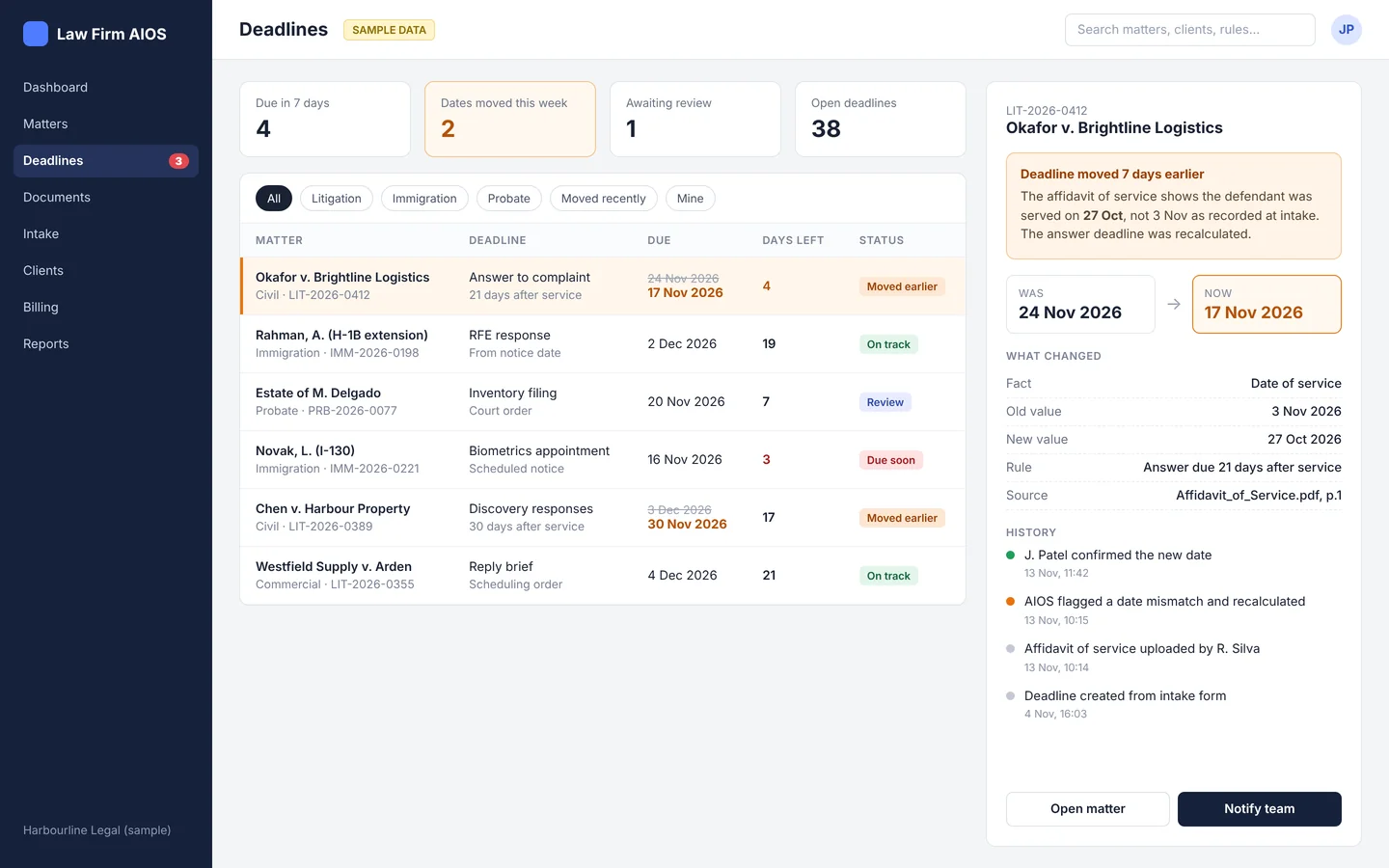
Nobody in that firm stopped using ChatGPT for a quick redraft. They stopped relying on memory for the work that can't be missed.
Does your firm need an AI policy?
Yes. Opinion 512 says managing lawyers must set clear policies on permitted AI use, and the SRA expects firms to supervise it. Your staff are almost certainly using these tools already. A short written policy turns private habits into rules you can supervise, explain to clients and defend if challenged.
A workable policy covers seven things:
Approved tools: which tools staff may use, on which plan, and who approved them.
What never goes in: client identifiers, privileged material, medical records and anything under a court order, unless the tool is one the firm has vetted for that use.
Client consent: when the firm tells clients about AI use, and when it asks for informed consent before using their information.
Verification: every citation, figure and quotation checked against a primary source by a named person before anything is filed or sent.
Supervision: who reviews AI-assisted work by trainees and support staff, and how.
Billing: how AI-assisted time is recorded and charged, and that learning time isn't billed to clients.
Records and review: where AI-assisted work is logged on the file, and a date each year to review the policy against new bar and regulator guidance.
Keep it to two pages. A policy people read beats a perfect one nobody opens.
FAQ
Can lawyers use ChatGPT?
Yes. ABA Formal Opinion 512 (2024) and state bar guidance allow it, provided lawyers understand the tool, protect client confidences, verify everything it produces, supervise staff use and bill fairly. The lawyer stays responsible for the work, whatever tool helped draft it.
Is ChatGPT safe for confidential client information?
Only with the right plan, settings and client consent. OpenAI says it doesn't train on ChatGPT Business, Enterprise or API data by default, while consumer chats can be used for training unless that setting is off (as of November 2026). Opinion 512 says informed consent is needed before client information goes into a self-learning tool.
Can solicitors in the UK use ChatGPT?
Yes. The SRA has said firms remain accountable for AI output and must protect confidentiality and privilege, and the Law Society's generative AI guide confirms the SRA Principles and Code of Conduct still apply. Firms should set rules on which tools staff may use and check every citation.
Can ChatGPT replace lawyers?
No. It drafts quickly but invents authorities, can't exercise judgment about a client's interests and carries no professional accountability. Courts in the US, England and South Africa have sanctioned or referred lawyers who filed citations to cases that did not exist without checking them.
What should a law firm AI policy include?
Approved tools and plans, what must never be entered, when to tell clients or get their consent, how outputs are verified, who supervises, how AI-assisted time is billed, and how the policy is recorded and reviewed. Two pages is enough for most firms.
Can a custom legal AI system use GPT or Claude underneath?
Yes. A custom system can call a commercial language model through the provider's business API, while the firm's matters, deadline rules and records stay in its own workspace. Check the provider's API terms on training and retention; OpenAI, for example, says API data isn't used for training by default (November 2026). Creative Upaay builds on relevant orchestration of models like Google’s Gemini, Anthropic's Claude or Open AI's Chat GPT, we route all of them through Openrouter.
Already using ChatGPT? See what a system built around your firm adds, in 30 minutes
Talk to us →About the author
Sourabh Purbia, CEO & Co-Founder, Creative Upaay
Sourabh Purbia co-founded Creative Upaay in 2019 and leads it as CEO. The company builds custom AI for businesses that run on documents, deadlines and follow-ups, and has delivered 350+ projects for 85+ clients worldwide, from a personal-injury law practice in South Africa to coaching institutes in India.
LinkedIn →Keep reading
Legal
How law firms stop missing limitation deadlines: a practical deadline tracking guide
Jan 05, 2027 · 10 min read
Legal
Law firm automation: what to automate first, and what to leave to lawyers
Dec 01, 2026 · 12 min read
AI for Business
How AI can help a business that runs on documents, deadlines and follow-ups
Feb 02, 2027 · 12 min read