
Legal
Jan 05, 2027
•
10 min read
How law firms stop missing limitation deadlines: a practical deadline tracking guide

Sourabh Purbia · CEO & Co-Founder, Creative Upaay
Last updated Jan 05, 2027
Law firms stop missing limitation deadlines when every deadline is stored as a calculation (a rule, the facts it depends on and the result) and that calculation is re-run whenever a fact changes. A calendar entry typed in once can't do that. A good law firm deadline tracker checks every open file, every day, and tells a named person when something moves. This guide covers how limitation dates are calculated, why they change, what's at stake when one is missed, and how to build that safety net in five steps.
This article is general information, not legal advice.
Why do law firms miss limitation deadlines?
Law firms rarely miss limitation deadlines because nobody cared. They miss them because the date was calculated wrongly, a fact changed and nobody recalculated, a quiet matter dropped out of sight, the person who knew the file left, or one careful person was the whole safety net and had a bad week.
Calculation errors are the obvious cause: the wrong start date, the wrong period, or an extension nobody applied.
Changed facts are the quieter cause, and arguably the more dangerous one. A client mentions on the third call that they were 16 at the time of the accident. A medical report shows the injury was diagnosed a year after the incident. A second defendant turns up. Each of these can move the date, but the date in the calendar was entered on day one and nobody goes back to it.
Then there's the human side. Quiet matters get no attention until something forces it. Staff leave and take a file's quirks with them. And many firms rely on one person who keeps the diary in their head as much as in the system.
Malpractice insurers track this. The American Bar Association's Standing Committee on Lawyers' Professional Liability publishes the Profile of Legal Malpractice Claims; the most recent edition we could confirm covers 2020 to 2023 and was published in September 2024. Its editions have repeatedly listed calendaring and deadline errors among the administrative mistakes behind claims, which is why insurers push firms to keep a second, independent check on every limitation date.
How to calculate a limitation deadline, and why it changes
A limitation deadline is calculated by taking the date time starts to run, adding the period the law sets for that kind of claim, then adjusting for anything that pauses, delays or extends it: the claimant being a minor, a later date of knowledge, or a rule specific to the claim type. Any input can change.
Separate the five inputs, because each can be wrong on its own.
The start date. Often the incident, but some regimes start when the claimant knew, or should have known, the facts.
The period. Set by statute and different for different claims.
Pauses and extensions. Rules that stop time running or push the end date back, called tolling in the US.
The claimant's status. Minors and people lacking legal capacity are often treated differently.
Date of knowledge. When the claimant learned they were injured, and by whom.
Here is a worked example using a made-up rule set, so the numbers don't describe any real jurisdiction. Assume the rule is three years from the incident, that time doesn't run while the claimant is a minor, and that the age of majority is 18.
A client comes in on 1 February 2026 about an accident on 10 March 2025. At intake, nobody records their date of birth. The calendar says 10 March 2028.
On the third call, the client mentions they were 16 at the time, with a birthday of 1 September 2008. Under our made-up rule, time starts on their 18th birthday, 1 September 2026, so the deadline becomes 1 September 2029: about 18 months later.
Now flip it. Suppose the firm had recorded a date of birth that made the client a minor, when in fact they were already 18. The real deadline is the earlier one, and a firm relying on the later date would miss it. Changed facts can move a deadline either way.
What happens when a lawyer misses a limitation deadline?
When a limitation deadline is missed, the client's claim is usually barred, or open only through a narrow court discretion. The client may then have a negligence claim against the firm, valued around what they lost. The firm will normally need to notify its professional indemnity insurer promptly, and regulatory consequences can follow.
In most systems, once the period has run, the defendant can rely on limitation or prescription as a complete defence. Some regimes give courts a limited discretion: in England and Wales, for example, section 33 of the Limitation Act 1980 lets a court disapply the personal injury time limit in some circumstances. That is a discretion, not a safety net, and arguing it costs time and money.
The former client can then claim against the firm for the value of the lost claim, so the firm ends up litigating a case within a case. Read your professional indemnity policy's notification terms and tell your insurer early. Regulators may also look at supervision and systems.
That's why the deadline engine comes before almost anything else when we automate a litigation practice.
Limitation periods in the US, UK and South Africa
Limitation periods are set by statute and differ by jurisdiction and type of claim. In the US each state sets its own. In England and Wales the main statute is the Limitation Act 1980. South Africa uses the Prescription Act 68 of 1969, with separate rules for Road Accident Fund claims. Always check the current text and case law.
The table summarises a few of the general rules, checked against the statute text on 13 November 2026. It is a starting point for your firm's rule list, not a statement of the period that applies to any particular claim.
Jurisdiction | Primary source | General rule (examples) | What can move the date |
|---|---|---|---|
United States | Each state's own statutes | Periods vary by state and by type of claim; there is no single national period | State-specific rules on tolling, discovery of the injury and minority |
England and Wales | Personal injury: three years from when the cause of action accrued, or the claimant's date of knowledge if later | Date of knowledge (section 14); disability, which includes being a child (section 28); court discretion (section 33) | |
South Africa (general) | Prescription Act 68 of 1969, sections 11 to 13 | Most debts: three years, unless another Act of Parliament says otherwise. A non-contractual debt isn't due until the creditor knows the debtor's identity and the facts | Section 13: completion is delayed for impediments such as the creditor being a minor, and isn't completed until a year after the impediment ends |
South Africa (Road Accident Fund claims) | Road Accident Fund Act 56 of 1996, section 23 | Where the driver or owner is identified: three years from the date the cause of action arose. A claim lodged with the Fund in time doesn't prescribe before five years from that date | Section 23 applies "notwithstanding anything to the contrary in any law", so check it separately from the general rules |
Notice how many of the "what can move the date" entries depend on facts you only learn by asking: the client's age, when they found out, who the other side is. These schemes also interact. A Road Accident Fund matter in South Africa needs both the Fund's own timetable and the court deadlines that follow it, which is why the practice in the example below needed more than one kind of check.
Law firm deadline tracker: calendar reminders vs a deadline engine
A calendar stores a date someone calculated once. A deadline engine stores the rule and the facts, recalculates when a fact changes, and re-checks every open matter daily. For limitation work, where facts change after intake, a law firm deadline tracker built as an engine catches what a calendar can't.
Calendar reminders | Deadline engine | |
|---|---|---|
What it stores | A date | The rule, the facts it depends on, and the result |
When a fact changes | Nothing, unless someone remembers | Recalculates and flags the change |
Quiet matters | Silent until the reminder fires | Flags matters with no activity for a set period |
Who gets told | Whoever owns the calendar | A named person, then an escalation if they don't act |
Audit trail | Who edited the entry, at best | Which rule produced which date, and when it was checked |
Many regimes at once | One entry per date, typed by hand | One rule per regime, applied to every matter |
Calendars are fine for court dates once set. Limitation dates are calculations that depend on facts, and facts arrive late.
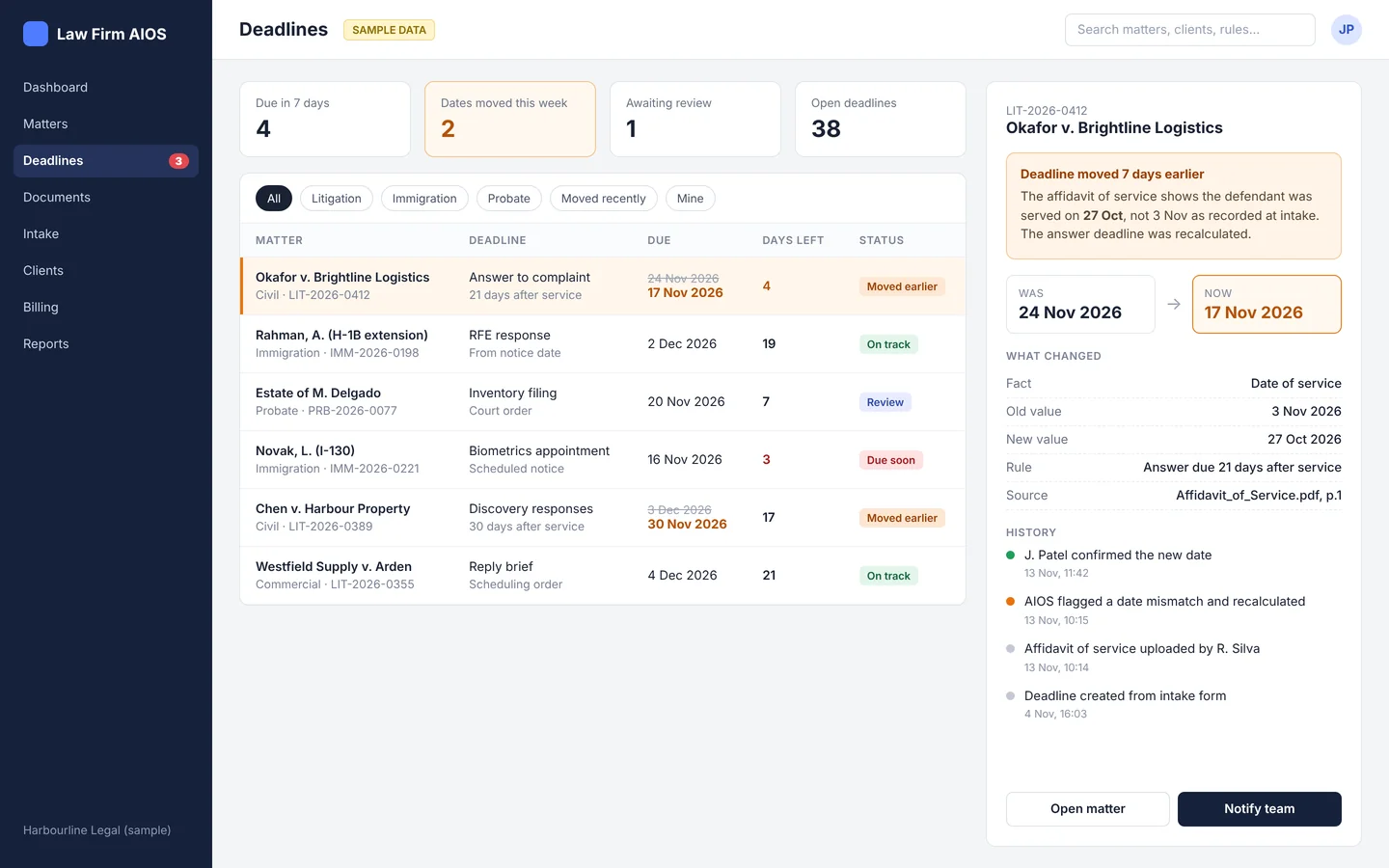
Example: We built Legal AIOS for a South African personal-injury practice that handles Road Accident Fund claims. It runs 24+ automatic deadline checks across every open matter, including limitation, summons and appeal deadlines, minors reaching majority, and matters that have gone inactive. Matters move through gated stages from intake to settlement, so a file can't progress without the facts its deadlines depend on. The practice reports 100% deadline compliance.
That result is one firm's own report. It shows the checks work for that firm's rules; no system replaces a lawyer who understands them. You can read more in our legal case study, and our guide to AI for personal injury law firms covers the rest of the matter lifecycle. For the general pattern behind it, see our piece on deadline and decision engines.
Docketing software for small law firms: what it covers and what it misses
Docketing software calculates court deadlines from court rules after a triggering event, such as service of a complaint. For US litigation against standard court calendars it does that job well. It usually doesn't know pre-action limitation periods that depend on client facts, or statutory schemes outside its rules library.
If most of your deadlines come from US court rules after proceedings start, buy docketing software. Its rules libraries are maintained by people whose job is tracking rule changes; don't rebuild that yourself.
The gaps show up before proceedings start and outside the US. A limitation date that depends on the client's age isn't a court rule. A scheme like the Road Accident Fund Act has its own timetable that a US court-rules product won't model. And docketing tools generally don't watch for matters that have gone quiet.
So the answer for many small firms is both: docketing for court rules, plus a rules engine for the statutory and fact-driven deadlines your practice depends on. Our Legal AIOS is built per firm on the tools it already uses, so it can sit alongside existing docketing instead of replacing it.
Build your firm's deadline safety net in 5 steps
These steps work on a spreadsheet; software makes them run daily without anyone remembering to.
List the rules. For each practice area, write every deadline rule in plain language: the period, the start date, what pauses or extends it, and the source. Have a lawyer sign the list off, and date it.
Capture the facts at intake. Every fact a rule depends on (date of incident, date of birth, date of knowledge, parties) becomes a required field. If it's unknown, record that it's unknown, because an empty field should itself raise a flag.
Run a daily automatic check. Recalculate every open matter's deadlines from the rules and current facts every day. Flag any date that moved since yesterday.
Set an alert and escalation path. Every alert goes to a named person, with a second person told if it isn't acknowledged within a set time. Make it impossible for one person's leave to switch off the safety net.
Audit monthly. Pick a sample of open files and recalculate by hand. Compare with the system. Review the rule list whenever the law or your practice changes.
Step 5 matters because a system never checked against a human calculation will eventually be trusted more than it deserves. For the wider picture, our guide to law firm automation explains where deadlines sit among everything else a firm can automate. The same rules-first approach works in any business that runs on documents, deadlines and follow-ups.
Send us your deadline rules and we'll show you what a daily check would flag
Talk to us →About the author
Sourabh Purbia, CEO & Co-Founder, Creative Upaay
Sourabh Purbia co-founded Creative Upaay in 2019 and leads it as CEO. The company builds custom AI for businesses that run on documents, deadlines and follow-ups, and has delivered 350+ projects for 85+ clients worldwide, from a personal-injury law practice in South Africa to coaching institutes in India.
LinkedIn →