
AI for Business
Dec 15, 2026
•
10 min read
AI voice agents for sales calls: how they work, is AI calling legal, and what to expect

Sourabh Purbia · CEO & Co-Founder, Creative Upaay
Last updated Dec 15, 2026
An AI voice agent for sales calls is software that phones your leads, holds a spoken conversation, updates your CRM and passes the call to a person when it should. It works best on follow-ups to people who already asked to hear from you, and it is legal in the US, UK and India only when you meet each country's consent and calling rules.
This guide takes the three questions founders ask, in order: how it works, whether it's legal, and whether it works. Creative Upaay builds custom AI for businesses that run on documents, deadlines and follow-ups, and one of those builds is a sales-calling agent, so the results section uses real numbers. We'll also say what those numbers don't prove.
What is an AI voice agent for sales calls?
An AI voice agent is a program that makes or answers phone calls in a natural, human-sounding voice. In sales, it calls leads to qualify them, confirm meetings, follow up and reschedule. It reads and writes your CRM as it goes, and hands the call to a salesperson when the conversation needs one.
There is no fixed recording and no press-1 menu. The agent listens to what the person said and answers it. That flexibility is also the risk, so a good deployment spends most of its effort on rules: what the agent may discuss, what it may promise, and when it must stop and fetch a human.
How do AI voice agents work?
AI voice agents run a loop on every turn of the conversation. Speech-to-text turns what the prospect said into words. A language model decides what to say next, using your instructions and the lead's CRM record. Text-to-speech speaks the reply. Around that loop sit the dialler, the CRM connection and the handover rules.
A single outbound call looks like this:
A trigger in the CRM (a new enquiry, a missed demo, a quote that went quiet) puts the lead in the dialler's queue.
Speech-to-text turns the prospect's answer into text.
The model reads its instructions, the lead's history and the conversation so far, then writes the next line.
Text-to-speech speaks it.
Outcome, notes and any booked meeting are written back to the CRM.
Handover rules are checked on every turn, and if one fires, the call goes to a person.
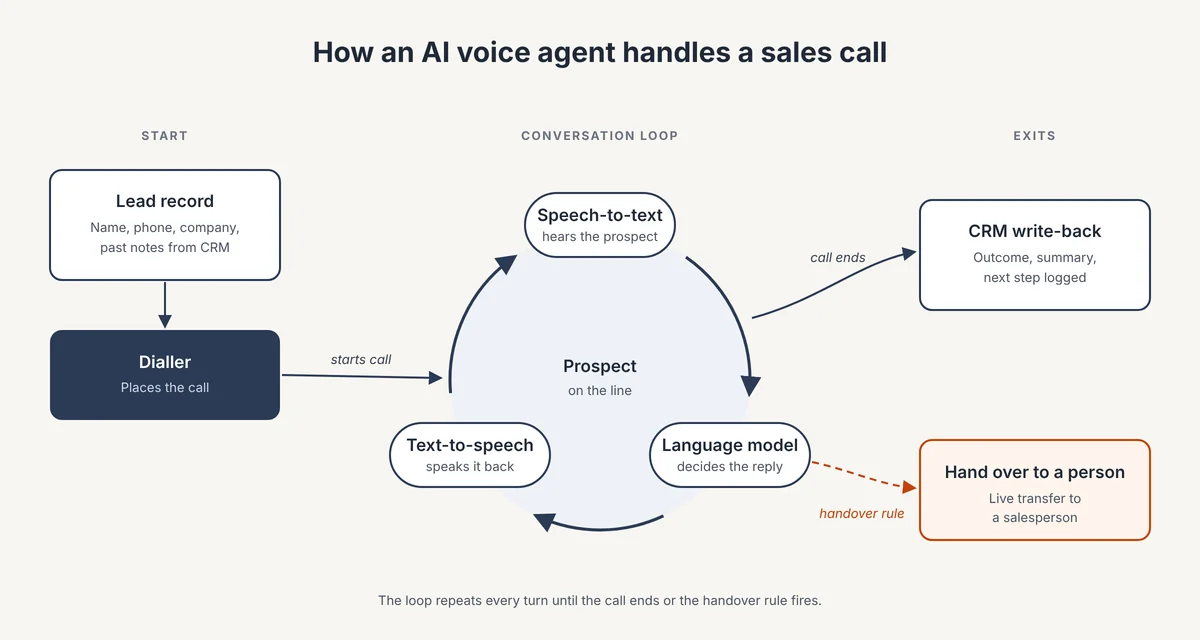
The CRM connection is what turns a talking demo into a sales tool. Without it, the agent can't know this lead had a demo last Tuesday, and your team can't see what the agent learned.
Can an AI agent make sales calls for you?
Yes. An AI agent can place outbound sales calls on its own and handle the whole conversation. It does best at short, structured calls: qualifying a new enquiry, confirming a demo, chasing a lead who went quiet, rescheduling a missed meeting. It does badly at complex negotiation, angry callers and anything where a wrong promise costs you money.
The good jobs have one goal, predictable answers and a result that fits in a CRM field. "Are you still interested, and does Thursday at 3 work?" is a perfect AI call.
A buyer haggling over contract terms or a customer furious about an invoice needs judgement and authority the agent shouldn't have. A well-built agent spots these early and hands over. A badly built one keeps talking.
AI cold calling vs AI follow-up calls: where it works
Start with follow-ups. Calls to people who filled in a form, asked for a callback or booked a demo are where an AI agent is safest and most useful. AI cold calling to strangers is the opposite on both counts, and in the US and UK the consent rules make it close to a non-starter.
For many sales teams the problem isn't a shortage of leads. It's the hours needed to call back the ones that came in on Friday afternoon. A follow-up call also has a clear test: the prospect books the next step or doesn't, so you know within weeks whether it's working.
Cold calling with an artificial voice runs straight into the rules below. If you hold the consent those rules require, the call isn't really cold. Follow-ups are one of three jobs where AI earns its keep in operations-heavy businesses; the full framework is in AI for documents, deadlines and follow-ups.
Is AI calling legal? US, UK and India
AI calling is legal in all three countries when you hold the right consent and follow the calling rules. In the US an AI voice counts as an "artificial voice", so you need prior express consent. In the UK automated marketing calls need specific consent. In India calls must come from registered senders on designated numbers and respect DND preferences.
This section is general information, not legal advice. These rules change, so check with a lawyer in each market before your agent dials anyone. Sources checked 13 November 2026.
United States: the TCPA and the FCC's 2024 ruling
The Federal Communications Commission's Declaratory Ruling, adopted 2 February 2024 and released 8 February, confirmed that AI-generated voices are an "artificial or prerecorded voice" under the Telephone Consumer Protection Act (TCPA). AI calls therefore need the called person's prior express consent, and prior express written consent for telemarketing. The message must identify the business at the start, and telemarketing calls must offer an opt-out.
In July 2024 the FCC also proposed rules requiring callers to disclose AI use at the start of each call. We found no final rule as of November 2026, so treat disclosure as good practice for now. State laws can add more.
United Kingdom: PECR, the TPS, the ICO and Ofcom
The ICO's telephone marketing guidance under the Privacy and Electronic Communications Regulations (PECR) splits calls in two. Live marketing calls don't generally need consent, but you must screen against the Telephone Preference Service (TPS) and Corporate TPS, keep a do-not-call list, say who's calling and show a number. Automated marketing calls need consent to automated calls specifically; general marketing consent isn't enough. The ICO says the same rules apply to calls to businesses.
That guidance doesn't mention AI voice agents. Our cautious reading is to treat a call with no human on the line as automated. The ICO notes the guidance is under review after the Data (Use and Access) Act, so check it again before launch. Ofcom covers the network side: its persistent misuse policy targets silent and abandoned calls from automated calling systems and expects a number people can call back.
India: TRAI's TCCCPR 2018 and DND
The Telecom Regulatory Authority of India (TRAI) governs commercial calls through the Telecom Commercial Communications Customer Preference Regulations, 2018 (TCCCPR). Customers set DND preferences, senders must register, and promotional calls may only reach people who haven't blocked that category or who have consented. The Second Amendment of 12 February 2025 points promotional calls to 140-series numbers and service and transactional calls to the 1600 series.
The Third Amendment of 18 September 2026 matters most for AI. It defines "Application-to-Person" (A2P) calls to include artificial voice technologies and requires senders to declare A2P calls to their telecom operator in advance; undeclared calls are treated as unsolicited commercial communication. That provision takes effect sixty days after publication in the Official Gazette.
Market | Main rules | What an AI sales agent needs | Primary source |
|---|---|---|---|
United States | TCPA; FCC Declaratory Ruling, Feb 2024 | Prior express consent (written for telemarketing), business identified at the start, opt-out on telemarketing calls | |
United Kingdom | PECR (ICO); Ofcom persistent misuse policy | Specific consent to automated calls; TPS and CTPS screening for live calls; caller ID shown | |
India | TRAI TCCCPR 2018, amended 2025 and 2026 | Registered sender, 140 or 1600 series numbers, DND respected, A2P calls declared |
What results can you expect from an AI calling agent?
Expect volume and consistency first, and plan to measure conversion yourself. In one deployment for a software company's sales team, the agent made 631 calls in its first 15 days. In about six weeks it handled more than 6,000 minutes of calls and saved the team more than 100 hours of call time.
Example: a software company's sales team. We built an AI sales-calling agent connected to Zoho CRM, with escalations on a dashboard and handover to live agents. It made 631 calls in its first 15 days. By November 2026, about a month and a half in, it had handled 6,000+ minutes of calls and saved the sales team 100+ hours of call time. Languages handled: It handles calls in English, Hindi, Hinglish and vernacular Indian languages.
What the numbers show: the agent works at volume, every day, connected to a real CRM, and it took routine calls off people who would rather spend those hours on buyers.
What they don't show is conversion. Minutes and hours saved are not deals. These figures don't tell you how many meetings were booked, how many became sales, or whether prospects responded better or worse than they would to a person. Measure an agent like a new salesperson: connect rate, qualified outcomes, meetings booked and, over a full sales cycle, closed deals against similar leads your team called. More on this build is in our voice AI case study.
When should the AI hand over to a human?
Hand over when the prospect asks for a person, shows buying intent the agent isn't allowed to close, gets upset, or takes the conversation into custom pricing, contract terms or complaints. Make the handover live where you can, and have the agent pass a short summary so the salesperson doesn't start from zero.
Write the rules down before launch: explicit requests ("can I speak to someone?"), topics the agent must never answer, signs of frustration such as repeated objections, and high-value moments where a person should take the win.
In the deployment above, escalations land on a dashboard the sales team watches, and calls can pass to a live agent. The dashboard also shows where the agent keeps getting stuck, which tells you what to fix next. We design follow-up and voice agents around that loop: the agent handles the routine, people handle the exceptions.
AI calling agent vs AI sales-call assistant
An AI calling agent makes the call itself, with no person on the line unless it hands over. An AI sales-call assistant sits alongside your salesperson during a call, transcribing, suggesting answers and writing notes afterwards. The agent takes routine calls off your team. The assistant improves the calls your team still makes.
AI calling agent | AI sales-call assistant | |
|---|---|---|
Who speaks to the prospect | The AI | Your salesperson |
Best for | Follow-ups, qualifying, reminders, rescheduling | Discovery calls, demos, negotiations |
What it saves | Hours of calling | Note-taking and prep |
Calling-rule exposure | Higher: artificial or automated voice rules apply | Lower, though call-recording consent still matters |
Needs from your CRM | Read and write access, plus handover rules | Read access and somewhere to save notes |
Assistants are usually off-the-shelf products. A calling agent that follows your rules, writes to your CRM and hands over the way your team works is more often built for you. Our guide to off-the-shelf vs custom AI sets out how to decide.
Tell us your call volume and we'll sketch your first voice agent
Talk to us →About the author
Sourabh Purbia, CEO & Co-Founder, Creative Upaay
Sourabh Purbia co-founded Creative Upaay in 2019 and leads it as CEO. The company builds custom AI for businesses that run on documents, deadlines and follow-ups, and has delivered 350+ projects for 85+ clients worldwide, from a personal-injury law practice in South Africa to coaching institutes in India.
LinkedIn →